Showing posts with label crops. Show all posts

Tuesday, April 12, 2011

Preserving biodiversity: Seed saving and Seed banks

Who preserves and controls crop biodiversity?  
How and why do they do it? 

* Agriculture, biodiversity and markets : livelihoods and agroecology in comparative perspective


* Agrobiodiversity hotspots : access and benefit sharing

* Banishing the biopirates : a new approach to protecting traditional knowledge


* Biopiracy of biodiversity : global exchange as enclosure

* Confronting biopiracy : Challenges, cases and international debates 

* Conserving plant genetic diversity in protected areas : population management of crop wild relatives


* Economics of managing crop diversity on-farm : Case studies from the Genetic Resources Policy Initiative


* Future control of food : a guide to international negotiations and rules on intellectual property, biodiversity and food security

* Garden seed inventory : an inventory of seed catalogs listing all non-hybrid vegetable seeds available in the United States and Canada

* Gardening with heirloom seeds : tried-and-true flowers, fruits, and vegetables for a new generation


* Genetic resources, traditional knowledge and the law : solutions for access and benefit sharing

* Governing agrobiodiversity : plant genetics and developing countries

* Heirloom tomato : from garden to table : recipes, portraits, and history of the world’s most beautiful fruit

* Heirloom vegetable gardening : a master gardener’s guide to planting, growing, seed saving, and cultural history

* Orchard invisible : a natural history of seeds

* Patenting lives : life patents, culture and development

* Plant conservation genetics

* Saving seeds : the economics of conserving crop genetic resources ex situ in the future harvest centres of the CGIAR

* Seed conservation : turning science into practice

* Seed diversity in the drylands : women and farming in South India

* Seed hunter [film]

* Seed to seed : seed saving and growing techniques for vegetable gardeners

* Seed trade in rural markets : implications for crop diversity and agricultural development

* Seeds, sex and civilization : how the hidden life of plants has shaped our world

* Sowing autonomy : gender and seed politics in semi-arid India


* Viking in the wheat field : a scientist’s struggle to preserve the world’s harvest


Tuesday, May 25, 2010

Updated: Crop Protection Compendium


UW-Madison Libraries subscribe to the Crop Protection Compendium database from CABI, which is now available on their new interface in beta.

This online multi-media resource can be searched by keyword, or browsed by animals (arachnids, molluscs, nematodes, birds, mammals), bacteria, fungi, oomycetes, plants, protozoa, unknown aetiology, and viruses.  It includes:

* 2,800+ detailed data sheets on crops, crop pests, diseases, weeds, invasive plants, natural enemies, pesticides and biopesticides

* Information on an additional 27,000 species, including distribution maps

* 8,000+ pictures to allow for easy identification and teaching

* 200,000 article records from the CAB Abstracts database (updated weekly), including 6,500 full-text journal and conference articles

* 9,000+ term interactive glossary

Wednesday, May 19, 2010

Plant Management Network: journals and more


UW-Madison is a partner of the Plant Management Network, managed by the American Phytopathological Society, American Society of Agronomy, and Crop Science Society of America.  Students, staff and faculty have full access to the site, including:

• Plant Health Progress - peer-reviewed journal focusing on plant protection; covers plant disease, entomology, and nematology of crops and ornamentals.

• Crop Management - peer-reviewed journal covering crop management practices, crop nutrients, and production agriculture; focuses on maximizing crop yield and value.

• Forage and Grazinglands - peer-reviewed journal covering animal nutrition and rangeland management.

• Applied Turfgrass Science - peer-reviewed journal covering the many aspects of turfgrass management.

• Plant Disease Management Reports - More than 5,000 searchable efficacy reports on various means of pest control, such as fungicides, nematicides, and biological controls. PDMR’s purpose is to help users determine the most effective chemicals and nonchemical pest management agents and to ensure maximum effectiveness/minimum use in terms of application. Reports cover various crops, ornamentals, turf and forage.

• Arthropod Management Tests - Efficacy reports of insecticides and other means of insect control. Helps users determine the most effective chemicals and brands in managing insects and also to ensure maximum effectiveness/minimum use in terms of application rates. Reports cover crops, ornamentals, turf and forage.

• Symposium/Meeting Proceedings - A collection of proceedings on topics related to agriculture and horticulture.

• Focus on Soybean - An online portal for growers, crop consultants, and researchers seeking information on producing healthy, high-yielding soybean crops. Features webcasts from noted extension agents on soybean crop production, protection, and management.

• Focus on Potato - An online portal for growers, crop consultants, and researchers seeking information on producing healthy, high-yielding potato crops. Features webcasts from noted extension agents on potato crop production, protection, and management.

• Focus on Ag Practitioners - A one-stop portal of agricultural resources for certified crop advisers, independent consultants, and other ag practitioners.

• PMN Image Collections - A collection of more than 4,000 plant disease and agricultural images for disease identification, class illustrations, and presentations.

Friday, April 30, 2010

New soybean pest: Trochanter mealybug

Infestations of the trochanter mealybug (Pseudococcus sorghiellus, in the Order Hemiptera, Suborder Homoptera, Superfamily Coccoidea and Family Pseudococcidae), an unarmored scale insect, were first identified in Midwestern soybean crops in 2008.  They can be found on the roots of soybeans that appear to be suffering from potassium deficiency (yellowing of the leaves).

See also...

* USDA NIFA grant - "Critical Issues: Emerging and New Plant and Animal Pests and Diseases"

* Wisconsin Pest Bulletin (v.54 n.1, 4/23/2010)

Related books & documents at UW-Madison:

* A systematic catalogue of the mealybugs of the world (Insecta, Homoptera, Coccoidea, Pseudococcidae and Putoidae) : with data on geographical distribution, host plants, biology, and economic importance

* Systematic analysis of the mealybugs in the Pseudococcus maritimus complex (Homoptera: Pseudococcidae)

* Handbook of soybean insect pests

* Pest management in soybean

* Soybean pest management in Wisconsin

* Pest management in Wisconsin field crops : a guide to managing weeds, insects, and diseases in corn, soybeans, forages, and small grains

* Some aspects of the biology and ecology of Orius insidiosus (Say) (Hemiptera: Anthocoridae) and a survey of arthropods on soybeans in south central Wisconsin

* Sulfhydryl-dependent inducible phytoalexins in juvenile soybeans predict insect resistance in fully developed plants

* Low-cost technology for controlling soybean insect pests in Indonesia

* Appraisal of insect-resistant soybeans, in Economic, environmental, and social benefits of resistance in field crops

* Two-spotted spider mite management in soybean and corn

* A nucleopolyhedrovirus for control of velvetbean caterpillar in Brazilian soybeans, in Biological control : a global perspective : case studies from around the world

* Biology and management of the soybean cyst nematode

* Soybean resistance to stem-mining agromyzid beanflies (Diptera: Agromyzidae) 

* American Soybean Association diagnostic guide

* Sampling methods in soybean entomology

Related research articles:

* Biswas, J., Ghosh, A.B.. (2000). Biology of the mealybug, Planococcus minor (Maskell) on various host plants. Environment and Ecology, 18(4): 929-932.

* Thippaiah, M.; Kumar, N.G. (1999). Dysmicoccus sp. (Pseudococcidae: Homoptera): a pest of soybean in Karnataka. Insect Environment, 5(2): 70.

* Jadhav, R.G.; Madane, N.P.; Kathamale, D.K. (1996). Record of soybean as a new host in India for citrus mealybug. Insect Environment, 2(3): 90.

* Kadiata, B.D.; Mulongoy, K.; Ntonifor, N.N. (1992). A severe mealybug infestation on some tree legumes. Nitrogen fixing tree research reports, 10: 70-72.

* Srivastava, O.S. (1972). Soybean, a new host record of mealy bug, Nipaecoccus vastator (Mask.) (Hemiptera: Pseudococcidae) in India. Indian Journal of Entomology, 34(3): 351-352.

Monday, June 8, 2009

Light harvesting in plants


24 highly-cited papers from 2003 to 2009 form a "research front" on light harvesting in plants, as reported at
Sciencewatch.com.

Topics covered include:
  • Carotenoid and regulation of light harvesting
  • Chloroplast protein kinase
  • Light stress
  • Organization of thylakoid proteins
  • Photo-inhibition
  • Photo-protection
  • Photosystem I - crystal structure
  • Photosystem II - core phosphorylation
  • Photosystem II - light-harvesting antenna
  • Photosystem II - repair
  • Plant antenna protein
  • Proteases in chloroplasts
  • Quenching
Papers in the research front:

Title: Crystal structure of spinach major light-harvesting complex at 2.72 angstrom resolution
Journal: NATURE, 428 (6980): 287-292 MAR 18 2004
Authors: Liu, ZF; Yan, HC; Wang, KB; Kuang, TY; Zhang, JP; Gui, LL; An, XM; Chang, WR


Title: Crystal structure of plant photosystem I
Journal: NATURE, 426 (6967): 630-635 DEC 11 2003
Authors: Ben-Shem, A; Frolow, F; Nelson, N

Title: Carotenoid cation formation and the regulation of photosynthetic light harvesting
Journal: SCIENCE, 307 (5708): 433-436 JAN 21 2005
Authors: Holt, NE; Zigmantas, D; Valkunas, L; Li, XP; Niyogi, KK; Fleming, GR

Title: Supramolecular organization of thylakoid membrane proteins in green plants
Journal: BBA BIOENERGETICS, 1706 (1-2): 12-39 JAN 7 2005
Authors: Dekker, JP; Boekema, EJ

Title: Rote of chloroplast protein kinase Stt7 in LHCII phosphorylation and state transition in Chlamydomonas
Journal: SCIENCE, 299 (5612): 1572-1575 MAR 7 2003
Authors: Depege, N; Bellafiore, S; Rochaix, JD

Title: Molecular basis of photoprotection and control of photosynthetic light-harvesting
Journal: NATURE, 436 (7047): 134-137 JUL 7 2005
Authors: Pascal, AA; Liu, ZF; Broess, K; van Oort, B; van Amerongen, H; Wang, C; Horton, P; Robert, B; Chang, WR; Ruban, A

Title: Evidence for direct carotenoid involvement in the regulation of photosynthetic light harvesting
Journal: PROCEEDINGS OF THE NATIONAL ACADEMIES OF SCIENCE OF THE USA, 100 (8): 4377-4382 APR 15 2003
Authors: Ma, YZ; Holt, NE; Li, XP; Niyogi, KK; Fleming, GR

Title: Photoinhibition - a historical perspective
Journal: PHOTOSYNTHESIS RESEARCH, 76 (1-3): 343-370 2003
Authors: Adir, N; Zer, H; Shochat, S; Ohad, I


Title: Is PsbS the site of non-photochemical quenching in photosynthesis?
Journal: JOURNAL OF EXPERIMENTAL BOTANY, 56 (411): 375-382 JAN 2005
Authors: Niyogi, KK; Li, XP; Rosenberg, V; Jung, HS


Title: Coordinated regulation and complex formation of YELLOW VARIEGATED1 and YELLOW VARIEGATED2, chloroplastic FtsH metalloproteases involved in the repair cycle of photosystem II in Arabidopsis thylakoid membranes Journal: PLANT CELL, 15 (12): 2843-2855 DEC 2003
Authors: Sakamoto, W; Zaltsman, A; Adam, Z; Takahashi, Y

Title: Molecular design of the photosystem II light-harvesting antenna: photosynthesis and photoprotection Journal:
JOURNAL OF EXPERIMENTAL BOTANY, 56 (411): 365-373 JAN 2005
Authors: Horton, P; Ruban, A

Title: Dynamics of photosystem II: a proteomic approach to thylakoid protein complexes
Journal:
JOURNAL OF EXPERIMENTAL BOTANY, 56 (411): 347-356 JAN 2005
Authors: Aro, EM; Suorsa, M; Rokka, A; Allahverdiyeva, Y; Paakkarinen, V; Saleem, A; Battchikova, N; Rintamaki, E

Title: Photosystem II core phosphorylation and photosynthetic acclimation require two different protein kinases Journal: NATURE, 437 (7062): 1179-1182 OCT 20 2005
Authors: Bonardi, V; Pesaresi, P; Becker, T; Schleiff, E; Wagner, R; Pfannschmidt, T; Jahns, P; Leister, D

Title: FtsH-mediated repair of the photosystem II complex in response to light stress
Journal:
JOURNAL OF EXPERIMENTAL BOTANY, 56 (411): 357-363 JAN 2005
Authors: Nixon, PJ; Barker, M; Boehm, M; de Vries, R; Komenda, J

Title: Protein degradation machineries in plastids
Journal: ANNUAL REVIEW OF PLANT BIOLOGY, 57: 599-621 2006
Authors: Sakamoto, W

Title: Photoprotection in an ecological context: the remarkable complexity of thermal energy dissipation
Journal: NEW PHYTOLOGIST, 172 (1): 11-21 2006
Authors: Demmig-Adams, B; Adams, WW

Title: Recent advances in the study of Clp, FtsH and other proteases located in chloroplasts
Journal: CURRENT OPINION IN PLANT BIOLOGY, 9 (3): 234-240 JUN 2006
Authors: Adam, Z; Rudella, A; van Wijk, KJ

Title: Identification of a mechanism of photoprotective energy dissipation in higher plants
Journal: NATURE, 450 (7169): 575-U22 NOV 22 2007
Authors: Ruban, AV; Berera, R; Ilioaia, C; van Stokkum, IHM; Kennis, JTM; Pascal, AA; van Amerongen, H; Robert, B; Horton, P; van Grondelle, R

Title: Lack of the light-harvesting complex CP24 affects the structure and function of the grana membranes of higher plant chloroplasts
Journal: PLANT CELL, 18 (11): 3106-3120 NOV 2006
Authors: Kovacs, L; Damkjaer, J;Kereiche, S; Ilioaia, C; Ruban, AV; Boekema, EJ; Jansson, S;Horton, P

Title: Psb27, a cyanobacterial lipoprotein, is involved in the repair cycle of photosystem II
Journal: PLANT CELL, 18 (11): 3121-3131 NOV 2006
Authors: Nowaczyk, MM; Hebeler, R; Schlodder, E; Meyer, HE; Warscheid, B; Rogner, M

Title: Architecture of a charge-transfer state regulating light harvesting in a plant antenna protein
Journal: SCIENCE, 320 (5877): 794-797 MAY 9 2008
Authors: Ahn, TK; Avenson, TJ; Ballottari, M; Cheng, YC; Niyogi, KK; Bassi, R; Fleming, GR

Title: Zeaxanthin radical cation formation in minor light-harvesting complexes of higher plant antenna
Journal: JOURNAL OF BIOLOGICAL CHEMISTRY, 283 (6): 3550-3558 FEB 8 2008
Authors: Avenson, TJ; Ahn, TK; Zigmantas, D; Niyogi, KK; Li, Z; Ballottari, M; Bassi, R; Fleming, GR

Title: Interorganellar communication
Journal:
CURRENT OPINION IN PLANT BIOLOGY, 10 (6): 600-606 DEC 2007
Authors: Pesaresi, P; Schneider, A; Kleine, T; Leister, D

Title: How do environmental stresses accelerate photoinhibition?
Journal: TRENDS IN PLANT SCIENCE, 13 (4): 178-182 APR 2008
Authors: Takahashi, S; Murata, N

Wednesday, April 8, 2009

Organic vs Conventional Production: Wisconsin Integrated Cropping Systems Trial


Researchers performing long-term agricultural studies in Wisconsin conclude that "...organic systems were more profitable than the Midwestern standards of continuous corn, no-till corn and soybeans, and intensively managed alfalfa" while "rotational grazing of dairy heifers was as profitable as the organic systems."

Further, "...organic forage crops can yield both as much dry matter as their conventional counterparts and with quality sufficient to produce as much milk..." and organic corn, soybean, and winter wheat "can produce 90% as well as their conventionally managed counterparts..." with weed control being a problem on average in one out of three years, and production being almost identical in two out of three years.

Original articles:

Chavas, J-P., Posner, J.L., Hedtcke, J.L. (2009). Organic and conventional production systems in the Wisconsin Integrated Cropping Systems Trial: II. Economic and risk analysis 1993-2006. Agronomy Journal 101:2, 288-295.

  • Currently free - future access via UW-Madison library online subscription

Posner, J.L., Baldock, J.O., Hedtcke, J.L. (2008). Organic and conventional production systems in the Wisconsin Integrated Cropping Systems Trials: I. Productivity 1990-2002. Agronomy Journal 100:2, 253-260.

  • UW-Madison access via library online subscription

More information:


Monday, March 30, 2009

Top 100 Plant Science Questions


"How can plant scientists change the world?"

Initiated by researchers in the School of Biological Sciences at the University of Bristol, "100 Plant Science Questions" invites submissions of pressing plant-related research issues facing the world today. Deadline: March 31st, 2009.

A panel drawn from academia, the public services sector and the corporate world will screen submissions.

From the website:

"Plant science is helping to address many of the big issues facing society today, such as food security, biofuels, and the effects of climate change, but what are the key questions that you think the next generation of plant scientists should be addressing?

Anyone is welcome to contribute their question, including members of the general public; agriculture, horticulture and forestry industries; ecologists; charities; policy makers; food, fibre, fuel and pharmaceutical industries; funding bodies; and researchers."

Wednesday, March 11, 2009

Rice database wins award


The Rice Bibliography Database of the International Rice Research Institute (IRRI) Library is the winner of the 2009 Oberly Award by the Association of College and Research Libraries.

This online search engine of the world’s scientific and technical rice literature has its roots in "The International Bibliography of Rice Research," first published in 1961 and then supplemented annually. Since 1996, the database has been online, and updated daily.

All publications represented by the database's 267,000+ entries are available in print or electronic format, and made available upon request.

More:

Tuesday, February 10, 2009

Wisconsin: Latest ag stats


The latest USDA Census of Agriculture was just released.

Wisconsin statistics:

  • # of farms in 2007: 78,463 (#9 in U.S.A.)

  • # of farms in 2002: 77,131

  • # of acres in farms 2007: 15,190,804

  • # of acres in farms 2002: 15,741,552

  • Average # of acres per farm 2007: 194

  • Average # of acres per farm 2002: 204

  • Commodities raised and delivered under production contracts (vegetables, melons and potatoes) - 527 farms (#2 in USA)

Organic agriculture:

  • 1,443 farms (#2 in USA)

  • 147,120 acres (#4 in USA)

  • $80,630,000 product sold (#4 in USA)

North American Industry Classification System:

  • Oilseed and grain farming: 13,508 farms

  • Vegetable and melon farming: 1,645 farms

  • Fruit and tree nut farming: 1,320 farms

  • Greenhouse, nursery, and floriculture operation: 2,147 farms

  • Other crop farming: 22,081 farms (#5 in USA)

  • Beef cattle ranching and farming: 11,593 farms

  • Cattle feedlots: 2,485

  • Dairy cattle and milk production: 13,081 farms (#1 in USA)

  • Hog and pig farming: 989 farms

  • Poultry and egg production: 2,297 farms

  • Sheep and goat farming: 1,501 farms

  • Animal aquaculture or other animal production: 5,816 farms - including 828 farms with colonies of bees
Specific crops:
  • Asparagus - 244 acres (#6 in USA)

  • Green lima beans - 3,435 acres (#3 in USA)

  • Snap beans - 70,885 acres (#1 in USA)

  • Beets - 2,784 acres (#1 in USA)

  • Head cabbage - 5,990 acres (#6 in USA)

  • Carrots - 3,988 acres (#4 in USA)

  • Cucumbers and pickles - 6,084 acres (#8 in USA)

  • Ginseng - 554 acres (#1 in USA)

  • Peas, Chinese (sugar and snow) - 69 acres (#5 in USA)

  • Green peas (excluding Southern) - 37,405 acres (#3 in USA)

  • Potatoes - 63,933 acres (#4 in USA)

  • Pumpkins - 3,600 acres (#8 in USA)

  • Winter squash 823 acres (#8 in USA)

  • Sweet corn - 91,218 acres (#3 in USA)

  • Corn for grain - 437,174,706 bushels

  • Corn for silage or greenchop - 11,645,140 tons (#2 in USA)

  • Mint for oil, All (pounds) - 325,782 (#5 in USA)

  • Oats for grain - 11,122,339 bushels

  • Soybeans for beans - 54,701,222 bushels

  • Sunflower seed - 4,449,621 pounds

  • Apples - 6,406 acres (#7 in USA)

  • Cherries - 2,567 acres (#3 in USA)

  • Cranberries - 18,696 acres (#1 in USA)

  • Currants - 11 acres (#4 in USA)

  • Raspberries - 286 acres (#9 in USA)

  • Aquatic plants - 1,342,175 dollars in sales (#7 in USA)

  • Flower seeds - 1,718,916 dollars in sales (#4 in USA)

  • Greenhouse fruits and berries - 28,927 dollars in sales (#4 in USA)

  • Mushrooms - 2,057,661 dollars in sales (#4 in USA)

  • Maple syrup - 108,108 gallons produced (#4 in USA)

  • Forage - land used for all hay and all haylage, grass silage, and greenchop (tons, dry equivalent) - 8,528,063 (#3 in USA)

  • Alfalfa hay (tons, dry) - 3,673,619 (#6 in USA)

  • All haylage, grass silage, and greenchop - 8,446,369 green tons (#1 in USA)

  • Hay, haylage, grass silage, and greenchop - 8,528,063 dry tons (#4 in USA)

  • Haylage or greenchop from alfalfa or alfalfa mixtures (tons, green) - 7,931,573 (#1 in USA)

  • Honey - 4,167,522 pounds collected
Inputs:
  • Manure - 2,011,176 acres treated

  • Commercial fertilizer, lime, and soil conditioners - 6,988,477 acres treated

  • Chemicals to control weeds, grass, or brush - 5,227,166 acres treated

  • Chemicals to control insects - 2,125,800 acres treated

  • Chemicals to control diseases in crops and orchards - 251,421 acres treated

  • Chemicals to control nematodes - 128,798 acres treated

  • Chemicals to control growth, thin fruit, ripen, or defoliate - 67,308 acres treated

Impact factors: Food science journals


Food science & technology journals
ranked by 2007 impact factor:

  1. Critical Reviews in Food Science and Nutrition

  2. Trends in Food Science and Technology

  3. Molecular Nutrition and Food Research (was Die Nahrung / Food)

  4. Food Chemistry

  5. Foodborne Pathogens and Disease

  6. International Journal of Food Microbiology

  7. Journal of Agriculture and Food Chemistry

  8. Food Hydrocolloids

  9. Journal of Dairy Science

  10. Food Research International

"The 2007 impact factor is calculated by taking the number of all current citations to source items published in a journal over the previous two years and dividing by the number of articles published in the journal during the same period--in other words, a ratio between citations and recent citable items published."

[Source: ScienceWatch, 2/1/09]

Thursday, February 5, 2009

Crop-eating caterpillars cause state of emergency


Achaea catocaloides rena has been identified as the insect destroying coffee, cocoa, banana and plantain farms, and contaminating water sources, across Liberia and Guinea in Africa.

According to CABI, "More than 20,000 people have so far had to evacuate their homes."

A. catocaloides rena is a member of the Noctuidae or "Owlet" moth family in the order Lepidoptera.

See also:
[Image of A. janata caterpillar (not A. catocaloides) by Djovani. Creative Commons Attribution-Noncommercial-No Derivative Works 2.0 Generic. http://www.flickr.com/photos/14126791@N03/1678406276]
[Copyrighted image of A. catocaloides rena moth used by permission of the Royal Museum for Central Africa, Belgium. http://www.metafro.be/lepidoptera/butterflies/RMCA-2171/taxon]

Friday, January 30, 2009

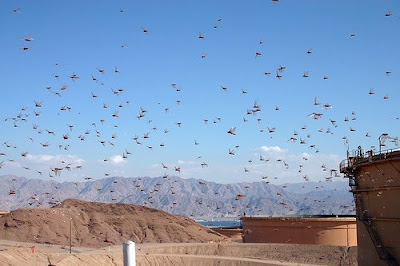
Locust swarms and serotonin


Original article:
Anstey, M.L., Rogers, S.M., Ott, S.R., Burrows, M., & Simpson, S.J. (30 January 2009). Serotonin mediates behavioral gregarization underlying swarm formation in desert locusts. Science 323 (5914): 627-630. [DOI: 10.1126/science.1165939]
  • Includes links to a longer commentary (Perspectives) and shorter commentary (ScienceNow), an author interview podcast and podcast transcript
You may also be interested in:
[Photo by niv. License: Creative Commons Attribution-Share Alike 2.0 Generic. http://www.flickr.com/photos/antichrist/34263361]

Global Research on Cocoa


GRO-Cocoa
- "Global Research On Cocoa: Working with and for farmers" - is a twice-yearly newsletter funded by the USDA and created by CABI.

All issues of the newsletter are available free online, back to issue #1 in June 2002.

CABI is "a not for profit, intergovernmental organization that improves people's lives worldwide by providing information and applying scientific expertise to solve problems in agriculture and the environment." They are publishers (ex: CAB Abstracts), researchers, consultants, and purveyors of microbial research services.

You may also be interested in: