Thursday, August 6, 2009

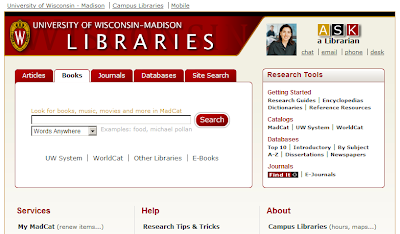
New campus library website!


The new UW-Madison Libraries website launched this week. The new design features:
  • A single tabbed search box for Articles, Books, Journals, Databases, and Site Search
  • Re-worded links, based on user testing
  • No deleted content
  • A commitment to continuous improvement

If you'd like assistance finding the new location for your favorite resources or services, please let me know.

As always, your feedback is greatly appreciated.

Note: the MadCat library catalog will soon undergo design changes, as well.

Coming soon: A new look for PubMed


The National Library of Medicine has announced that the PubMed database will soon undergo an interface redesign. Stated goals are to make PubMed easier to use, simplify the interface, refresh the look, better organize the text on the screen, and promote scientific discovery. NLM anticipates that the new design will be ready in mid-September.

Among the expected changes is the replacement of the current tab system (Limits, Preview/Index, History, Clipboard, Details) with a single screen combining many features onto one page.

The campus libraries offer hands-on training for PubMed (and many other research tools) - check soon for the
Fall workshop schedule.

FAQ:

  • What is the launch date? Proposed for mid-September.

  • Where have changes been discussed? June issue of the NLM Technical Bulletin.

  • Where will Single Citation Matcher & Clinical Queries be? Links will be on the front page and on Advanced Search.

  • Is “Preferences” replacing “MyNCBI”? Undecided.

  • What are the most results we can view on a page? Changing from 500 to 200 as a max.

  • Will there still be links to the MeSH database? Yes.

  • Will there be a direct export function to bibliographic management software? No, can’t support the many types of software.

  • Is Advanced Search changing? Not at this point.

  • Why not call it MySavedSearches instead of Preferences or MyNCBI? Because it includes functionality for all of the other Entrez systems.

  • Are there any plans for adjacency searching? No. Not part of the base technology.

  • Where will clipboard items be displayed? A link to access clipboard items will be available in the upper right hand corner, similar to the Limits message.

  • Will saved searches be lost when the new interface goes into effect? No.

  • Will LinkOut still exist? Yes

  • Will search screens for other NCBI databases change as well? Others will eventually change, unsure which ones and on what timeline.

  • Will cross-database searching be available? They are not implementing a new technology, just a change in appearance. The only cross database search capability is found on the Entrez home page.

  • Will it be possible to e-mail to more than one address? Not at this point as far as we know.

  • Will the library links to full text still be there? Yes, probably in the upper right corner on individual citation display.

  • Will we still have the ability in history to combine search numbers? Yes, will probably have to go to Advanced Search page.

  • What citation display views will we still have? All, except Citation and AbstractPlus won’t exist anymore.

  • Is it still possible to display text on the screen not as HTML? Yes, in Summary and Abstract views.

  • Will the hyperlinked MeSH terms in the display run a search or link to the database? They will probably only run a search, not link to MeSH database.

  • Where is "details"? Only by clicking into AdvancedSearch at this point.

  • Will Journals and MeSH database be available like on the sidebar now? Yes, on front page and through a drop-down menu above search box. Drop-down menu should be customizable in MyNCBI.

  • Is there a limit to the number of buttons for full-text access? Not that we are aware of.

  • Will the preview function still exist? Yes, on Advanced Search.

  • Will Powerpoint slides be available? Yes, in the June TB issue. A webinar recording will also be available later.

  • Are the limits available for both search boxes? There is only one search box.

  • Will there be another orientation when the new look debuts? Yes, including tutorials, quicktours, etc.

  • Where will limits be? Advanced Search page.

  • Where will history be? Advanced Search page.

  • Where will single citation matcher be? On the home page and on Advanced Search page.

  • Can you select to view MeSH terms in the citation record? Yes, you can set that preference in MyNCBI.

  • Can Advanced Search be set as the default searching page? No, the search box will be at the top of every page, so the page itself can’t be set.

  • Is it possible to get rid of the boxes on the right-hand side? You can click the minus sign, but they won’t totally go away.

  • Will we have to change our OutsideTool settings? No.

  • How much of a heads-up will we get? As much as we can get from NCBI.


[Thanks to Ebling Library blog]

Friday, July 31, 2009

Ulrich's Periodicals Directory maintenance: 7/31


The UW Libraries subscription to Ulrich's Periodicals Directory may be unavailable for as long as six hours on Friday, July 31, from 8:00 pm – 2:00 am Central Time.

Ulrichsweb.com is an authoritative source of information on and reviews for more than 300,000 periodicals — scholarly journals (including open access publications), magazines, newspapers, newsletters, zines and more from around the world.

Search for active, ceased and forthcoming periodicals by title, ISSN, subject, publisher/distributor, peer reviewed/refereed status, keyword, abstracting and indexing services, country/state/city of publication, language, frequency, open access status, price, etc.

Ulrich's is also connected to Journal Citation Reports (JCR), WorldCat, and UW-Madison's "Find It" tool.

Thursday, July 30, 2009

Informaworld maintenance: 8/1


The Informaworld database will be down:
  • Saturday, August 1st 5:00am- 7:00am
Informaworld is the interface for several publisher imprints, including Taylor & Francis and Routledge. Publications affected include:

Monday, July 20, 2009

Journal use at the UW-Madison


Online journal usage statistics for selected titles related to the plant and insect sciences at the UW-Madison:

Title - # Articles Accessed 2008

Cell - 26,926

Journal of Molecular Biology - 13,134

Current Biology - 9,482

Molecular Cell - 8,752

FEBS Letters - 7,193

Molecular Microbiology - 4,770

Virology - 4,344

Gene - 4,200

Forest Ecology and Management - 3,939

Current Opinion in Cell Biology - 3,629

Annals of the New York Academy of Sciences - 3,306

Chemistry & Biology - 3,247

Trends in Ecology and Evolution - 3,199

Current Opinion in Chemical Biology - 3,071

Trends in Cell Biology - 3,069
Atmospheric Environment - 2,971

Current Opinion in Structural Biology - 2,967

Biological Conservation - 2,849

Current Opinion in Plant Biology - 2,810

Current Opinion in Biotechnology - 2,791

Trends in Genetics - 2,625

Trends in Plant Science - 2,561

Soil Biology and Biochemistry - 2,451

Current Opinion in Microbiology - 2,435
Remote Sensing of Environment - 2,387

Ecological Modelling - 2,367
Journal of Power Sources - 2,290

Journal of Biotechnology - 2,260

Trends in Microbiology - 2,253

FEBS Journal - 2,139

Conservation Biology - 2,137

Chemosphere - 1,948

Biotechnology and Bioengineering - 1,888

Agriculture, Ecosystems and Environment - 1,799

Applied Microbiology and Biotechnology - 1,643

Cellular and molecular life sciences (CMLS) - 1,523

New Phytologist - 1,488

Proteomics - 1,480

Global Change Biology - 1,454

Oecologia - 1,452
Ecology Letters - 1,336

Science of the Total Environment - 1,334

Molecular Ecology - 1,317

FEMS Microbiology Letters - 1,264

Journal of Cellular Physiology - 1,249

Environmental Microbiology - 1,223

BioEssays - 1,208

Genomics - 1,204
Bioresource Technology - 1,074

Fungal Genetics and Biology - 1,064

FEMS Microbiology Letters - 1,049
Journal of Applied Microbiology - 1,024

Restoration Ecology - 997

Cellular Microbiology - 964

Landscape Ecology - 963

Animal Feed Science and Technology - 880
Plant Molecular Biology - 874

Ecosystems - 863

Plant Science - 859

Biometrics - 839

Journal of Applied Ecology - 808

Planta - 791

Environmental Management - 757

Biotechnology Letters - 695

Climatic Change - 679

Cytometry Part A - 639

Plant Cell & Environment - 623

FEMS Microbiology Ecology - 576

Plant and Soil - 573
Agricultural and Forest Meteorology - 564

Microbial Ecology - 563

Global Environmental Change - 551

Journal of Ecology - 546

Euphytica - 542

Biological Invasions - 534

Journal of Biogeography - 519

Plant Ecology - 483

Virus Research - 483

Biodiversity and Conservation - 470

Molecular genetics and genomics (MGG) - 463

Journal of the Science of Food and Agriculture - 459

Biogeochemistry - 441

Journal of Cereal Science - 436

Archives of Microbiology - 429

Applied Biochemistry and Biotechnology - 417

Journal of industrial microbiology & biotechnology - 415

Oikos - 412

Insect Biochemistry and Molecular Biology - 365

Friday, July 17, 2009

Biopesticide success with locust infestation


Green Muscle™ is a biopesticide that's proving successful against locusts in Africa. It consists of the spores of the Metarhizium anisopliae fungus, and is sprayed as a mineral oil suspension. Developed out of the LUBILOSA project, it is now produced by Biological Control Products (BCP) in South Africa and SenBio in Senegal. It has not as yet been approved for use in the United States.

BOOKS FOR MORE INFORMATION:

DOCUMENTS:

JOURNALS:

NEWS:

Sunday, July 5, 2009

Blight affecting tomatoes and potatoes


--------------------------------

UPDATE August 5, 2009: The Wisconsin Department of Agriculture, Trade & Consumer Protection confirms that late blight on tomato has appeared in Dane and Rock counties, the first cases of the disease in the state in six years. Full article: LATE BLIGHT ALERT
--------------------------------

Gardeners are being warned to destroy any Solanaceae plants (tomato, potato, eggplant) suspected of suffering from "late blight" disease, especially those purchased from big box stores.

The disease, associated with the Irish Potato Famine of the 1840's, is caused by the Phytophthora infestans fungus. While not harmful to humans, it is extremely contagious and deadly to plants.

Books:


Conference proceedings:

Video:

UW-Madison dissertations & theses:

UW-Madison patent:

UW Extension Report:

More information:

Thursday, July 2, 2009

Ant symbiosis and Biofuels

[Photo: B W Hoffman]

UW-Madison Communications recently covered a project of the Great Lakes Bioenergy Research Center to sequence the genome of ants that break down and digest cellulose, along with their associated fungi and bacteria ("Sequencing effort to chart ants and their ecosystem").

Recent publications by this project's researchers include:

Adams, A.S., Currie, C.R., Cardozea, Y.J., Klepzig, K.D., & Raffa, K. 2009. Effects of symbiotic bacteria and tree chemistry on the growth and reproduction of bark beetle fungal symbionts. Canadian Journal of Forest Research 39(6): 1133–1147.

Caldera, E.J., Poulsen, M., Suen, G., & Currie, C.R. 2009. Insect symbioses: a case study of past, present, and future fungus-growing ant research. Environmental Entomology 38: 78-92.

Ivens, A.B.F.; Nash, D.R.; Poulsen, M.; Boomsma, J.J. 2009. Caste-specific symbiont policing by workers of Acromyrmex fungus-growing ants. Behavioral Ecology 20:2, 378-384.

Little, A.E.F & Currie, C.R. 2008. Black yeast symbionts compromise the efficiency of antibiotic defenses in fungus-growing ants. Ecology 89: 1216-1222.

Oh, D.C, Scott, J.J., Currie, C.R., & Clardy, J. 2009. Mycangimycin: a polyene peroxide from a symbiotic Streptomyces sp. Organic Letters 11: 633-636.

Oh, D.C., Poulsen, M., Currie, C.R., & Clardy, J. 2009. Dentigerumycin: the bacterially produced molecular mediator of a fungus-growing ant symbiosis. Nature Chemical Biology 5: 391-393.

Oh, D.C., Scott, J.J., Poulsen, M.Z., Currie, C.R., & Clardy, J. 2008. Discovery of new secondary metabolites mediating insect-microorganism symbioses. Planta Medica 74(9): 906.

Poulsen, M., Fernandez-Marin, H., Wcislo, W.T., Currie, C.R., & Boomsma, J.J. (in press). Ephemeral windows of opportunity maintain horizontal transmission of fungal symbionts in leaf-cutting ants. Evolution.

Poulsen, M. & Currie, C.R. 2009. On ants, plants and fungi. New Phytologist 182(4): 785-788.

Scott, J.J., Oh, D.C., Yuceer, M.C., Klepzig, K.D., Clardy, J., et al. 2008. Bacterial protection of beetle-fungus mutualism. Science 322: 63.
Library Express system maintenance 7/3-7/4


**
Library Express will be unavailable from 10 pm on Friday night (July 3) until 3 am Saturday morning (July 4) for system maintenance. **

What is Library Express?

Library Express is the UW-Madison's "document delivery" and "interlibrary loan" (ILL) service.

UW-Madison students, staff and faculty may also use Library Express to request books sent by mail, if they're living outside of Dane County. For more information, see Distance Services.

What can be requested?

  • Articles scanned from print journals located on campus
  • Articles not available in print on campus, or through online subscription
  • Books not available in print on campus, or through online subscription

What can NOT be requested?

  • More than 50 requests per week
  • Books available on campus - instead, use "Place Requests" in MadCat to have these sent to your preferred pick-up library
  • Books available at other UW System campuses (ex: UW-Milwaukee) - instead, use "UW System Search" in MadCat and "Place Requests" to have these sent to your preferred pick-up library
  • Articles longer than 50 pages from journals that are available in print on campus. However, if the article is not available on-campus, then there is no page limit.
  • Articles available in full-text PDF online through library subscriptions - check find it button
  • These items are very difficult to borrow from off-campus:
    • Audiovisual materials including videos and CDs
    • Computer software and manuals
    • Genealogical resources
    • Materials for class reserve or group use - talk to your Reserves contact about purchasing copies instead
    • Rare books
    • Recently published books - if rejected, use the "Purchase Recommendation form"
    • Reference materials
    • Technical reports and standards
    • Textbooks
    • Whole volumes or issues of periodicals

Wednesday, June 24, 2009

2008 Journal impact factors released


2008 Journal impact factors released

Thomson Reuters has just published the 2008 Journal Citation Reports, available to UW-Madison library users. These metrics, including the "impact factor," can be used to compare journal performance. JCR includes 8,000+ highly cited, peer-reviewed journals from around the world.

New features:

  • 350+ new journals with their first published impact factor
  • Updated 5-year impact factors and Eigenfactor metrics
  • "Journal self cites" analyzes the contribution of self-citation to the impact factor (20 journals were dropped from JCR due to high self citation rates)
  • "Rank in category" for each journal's subject area, along with a box plot of impact factor distribution for all journals in that category

Top 3 in Agronomy by impact factor:

  1. Agricultural and Forest Meteorology
  2. Theoretical and Applied Genetics
  3. Advances in Agronomy

Top 3 in Entomology by impact factor:

  1. Annual Review of Entomology
  2. Advances in Insect Physiology
  3. Insect Molecular Biology

Top 3 in Horticulture by impact factor:

  1. Theoretical and Applied Genetics
  2. Tree Genetics and Genomes
  3. Postharvest Biology and Technology

Top 3 in Plant Sciences by impact factor:

  1. Annual Review of Plant Biology
  2. Annual Review of Phytopathology
  3. Plant Cell